Home > Netwerk kabel > KAT6A
Cat6a (Category 6a) is a high-performance Ethernet cable that provides greater speed and reliability compared to older cable standards. It is an improvement over Cat6, which can support data transfer speeds of up to 10 Gigabits per second (Gbps) over distances of up to 55 meters.
Cat6a maintains the same bandwidth as Cat6 but has improvements in the design and construction of the cable. It uses thicker copper wires, additional shielding, and tighter twists in the wire pairs to reduce crosstalk and interference between them. This allows it to support data transfer speeds of up to 10 Gbps at longer distances than Cat6, up to 100 meters.
Specificatie:
hoogwaardige CAT6 UTP 4-aderige netwerkkabel
·Monster beschikbaar.
·OEM-diensten.
·Officiële certificering: ROHS, CE, UL
Materiaalinstructie
·CCA of 24AWG zacht blank koper.
·Milieuvriendelijke, schone en nieuwe materialen geselecteerd. Wij garanderen uitsluitend nieuwe materialen.
·Isolatie: Massief HDPE;
·Milieuvriendelijke PVC/LSZH-mantel, bestand tegen hoge temperaturen, lange levensduur.
toepassingen:
·Project voor de bekabeling van een computernetwerk.
·Breedbandnetwerkcommunicatie.
·Digitaal ISDN-netwerk en ATM 155Mbps-netwerk
·Ethernet-netwerk
·Audio- en gegevensoverdracht
Kerngeleider: zuurstofvrij koper
Kenmerken: Hoge kwaliteit, verguld contact, duurzaam.
Productmateriaal: Kunststof+OFC
Product kleur: transparant
Materiaal van de jas: milieuvriendelijk plastic
Toepassingsgebied: router, IP-camera, netwerkcamera, laptop, computer.
Kenmerken:
·Categorie 6A S/FTP-kabel is bedoeld voor snelle dataoverdracht.
·toepassingen zoals: IEEE 802.3, 10BASE-T, 1000BASE-TX en
·10GBASE-T, 155 Mb/s ATM, 4/16 Mb/s Token Ring
·Gespecificeerd en getest tot 500 MHz
·Kleine, ronde designparen
Kenmerken:
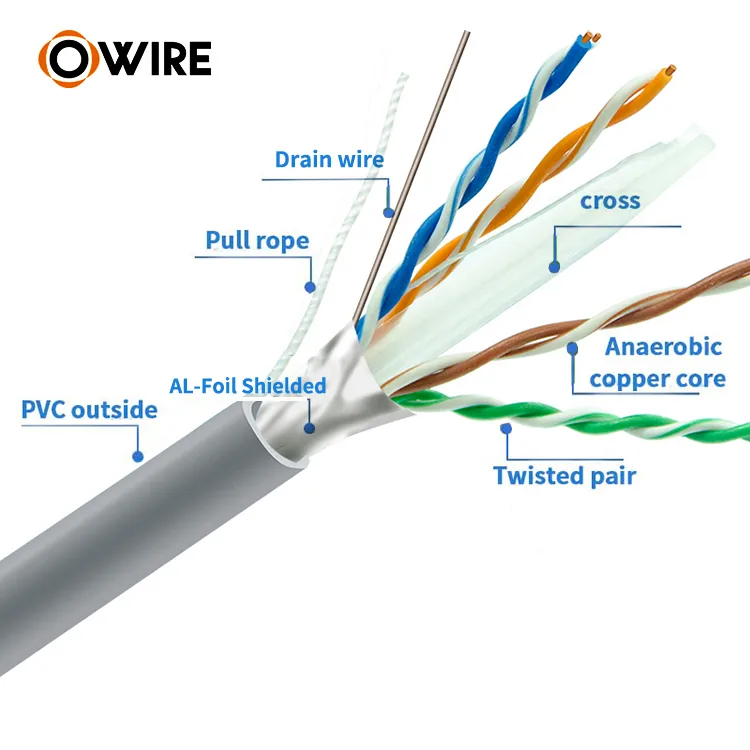
·Dubbele afscherming garandeert een sterke bescherming tegen storingen en gegevensbescherming.
·Snelle en betrouwbare verbinding
·Gedraaide paren met een heldere kleur voor gemakkelijke herkenning.
·Trekkoord en voetmarkering voor gemakkelijk gebruik
·Gladde jas voor gemakkelijk aantrekken in krappe ruimtes.
·Verkrijgbaar in lichtgrijs, donkergrijs, blauw, wit of naar uw wens.
Cat6 and Cat6a are both Ethernet cable standards that provide high-speed networking capabilities, but there are some differences between the two.
Speed: Cat6 can support data transfer speeds of up to 10 Gigabits per second (Gbps) over distances of up to 55 meters. Cat6a, on the other hand, can support speeds of up to 10 Gbps over longer distances of up to 100 meters.
Shielding: Cat6a offers more extensive shielding than Cat6, with individual shielding for each pair of wires in addition to an overall braid shield surrounding all four pairs. This makes Cat6a less susceptible to electromagnetic interference (EMI) and crosstalk.
Cable thickness: Cat6a cables are typically thicker than Cat6 cables due to the additional shielding and thicker copper wires used in their construction.
Cost: Cat6a is generally more expensive than Cat6 due to its higher performance and more extensive shielding.
CAT6A and CAT6A UTP are both types of network cables used for high-speed data transmission. The main difference between the two is that CAT6A is shielded, while CAT6A UTP is unshielded.
CAT6A cables are designed with an overall foil shield or a braided shield to protect against electromagnetic interference (EMI) and radio frequency interference (RFI). This shielding provides better performance in noisy or high-interference environments, making it more suitable for industrial or commercial applications.
In contrast, CAT6A UTP cables do not have any shielding. Instead, they rely on the twisting of pairs of wires within the cable to cancel out electromagnetic interference. While this makes them less expensive than shielded cables, they may not perform as well in high-interference environments.
CAT6A (Category 6A) cable is a type of twisted pair cable used in Ethernet networks to transmit data at high speeds. It is an improvement over its predecessor, CAT6 cable, and is designed to support faster data transfer rates and higher frequencies.
CAT6A cables have four pairs of copper wires that are tightly twisted together, which helps to reduce crosstalk between the wires. They are typically terminated with RJ45 connectors and can support data transfer speeds up to 10 gigabits per second (Gbps) over distances of up to 100 meters.
One of the key features of CAT6A cables is their ability to support 10GBASE-T Ethernet, which is a standard for 10 Gbps Ethernet over copper cabling. This makes them ideal for use in high-bandwidth applications such as data centers, server rooms, and other environments where fast and reliable network connections are required.
CAT6A cables also feature improved insulation and shielding compared to CAT6 cables, which helps to reduce electromagnetic interference (EMI) and improve signal quality. They can be either shielded or unshielded depending on the specific requirements of the network.
CAT6A and CAT8 are both types of twisted pair cables used for high-speed data transmission in Ethernet networks. However, there are several differences between the two.
Firstly, CAT8 is a newer and more advanced standard than CAT6A. It was introduced in 2019 and is designed to support even faster data transfer rates and higher frequencies than CAT6A.
Secondly, while CAT6A can support data transfer speeds up to 10 Gbps, CAT8 can support speeds up to 40 Gbps at distances of up to 30 meters. Beyond 30 meters, the speed drops down to 25 Gbps for distances up to 50 meters.
Thirdly, CAT8 cables have thicker wire gauges and more shielding than CAT6A cables. They use an S/FTP (screened/foiled twisted pair) configuration with both individual pair shielding and an overall braid shield to provide better protection against interference and crosstalk.
Finally, CAT8 is more expensive than CAT6A due to its advanced features and capabilities.