

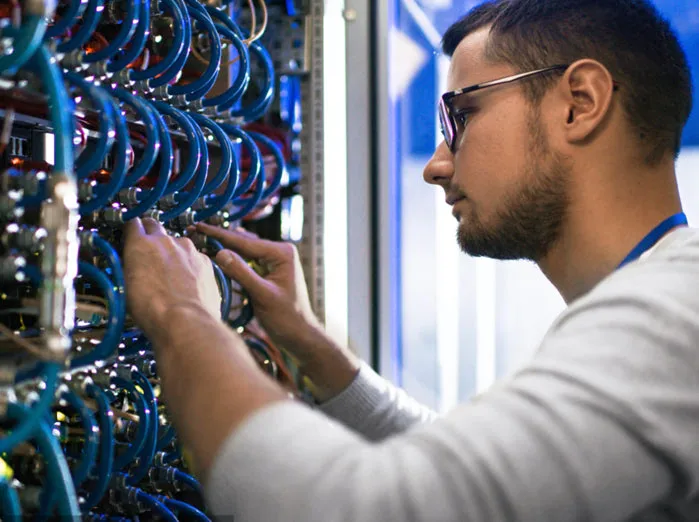

Drag chain Ethernet cable in an automated warehouse shuttle, stacker crane, gantry, transfer car, or robotic handling system must carry data while repeating a defined motion for a long operating period. A cable selected only by Cat5e or Cat6 marking can fail if conductor stranding, pair geometry, shielding, jacket, bend radius, acceleration, chain fill, and installation do not suit the axis. Procurement teams should provide the communication requirement and a motion profile: travel, unsupported length, bend radius, speed, acceleration, cycles, temperature, chemicals, flex direction, power proximity, termination, and maintenance expectations. That creates a defensible basis for cable construction and qualification.
Distinguish Continuous Flex from Ordinary Patch Cable
A fixed-installation cable may tolerate occasional movement during installation but is not designed for millions of controlled bends. A flexible patch cord can support handling yet still lack a verified drag-chain life under the project's radius, speed, and acceleration. Buyers should request a construction intended for continuous flex and evaluate the supplier's test conditions. Cycle claims are meaningful only when the bend radius, travel, speed, temperature, chain geometry, cable position, and failure criteria are stated. The finished assembly also includes connectors, overmold, strain relief, and routing; a strong bulk cable can still fail at an unsupported termination or an improperly anchored chain end.
Define the Network and Power Requirement
State the Ethernet category, conductor size, maximum channel length, data rate, protocol, PoE type and load where applicable, connector, patching, and acceptance-test requirement. Moving equipment may combine cameras, scanners, safety devices, controls, and industrial computers, each with different bandwidth and power needs. Confirm whether the cable is a permanent link, patch assembly, or machine-internal component. If PoE is used, review conductor resistance, bundle heating, ambient temperature, and voltage drop across the moving path. Do not assume that a high category rating alone proves suitability for flex life, industrial noise, oil exposure, or the machine's complete communication channel.
Match Conductors, Shielding, and Jacket
Fine stranded conductors improve flexibility but affect resistance, termination, and transmission design. Pair lay and separator construction must remain stable through motion. Choose UTP, overall foil, braid, or combined shielding from the electromagnetic environment and grounding concept rather than habit. The jacket must suit abrasion, oil, coolant, cleaning agents, temperature, flame, low-smoke, halogen, UV, and indoor or outdoor exposure as required. PUR can be useful in demanding moving applications, while other compounds may fit different cost and environmental needs. Request a written construction and compatibility review, including all conductors, shields, drain wire, separator, fillers, and jacket.
Provide the Complete Motion Profile
The cable manufacturer needs chain bend radius, inner dimensions, travel distance, self-supported or gliding operation, movement speed, acceleration, jerk, cycles per hour, duty hours, installation orientation, temperature, and expected service life. Identify torsion, lateral movement, reverse bending, or combined motion because a standard drag-chain design may not cover them. Note nearby hydraulic hoses, power cables, abrasive dust, sharp edges, and contamination. When several axes use the same cable, supply the worst-case and common conditions. A motion sketch or short video, together with chain and machine drawings, is often more useful than a generic request for a high-flex industrial Ethernet cable.
Engineer Chain Fill and Installation
Respect the cable and chain suppliers' guidance on minimum dynamic bend radius, clearance, separation, weight distribution, and fill. Cables should be laid without twist, forced crossing, excessive tension, or tight ties. Use suitable dividers when power, fluid, and data components share a chain. Align and secure the fixed and moving ends so strain relief does not create a new bend point. Allow the cable to settle in the chain before final fastening. Label both ends and record route, axis, part number, revision, installation date, and test result. Correct installation is part of the product qualification; a cable cannot compensate for an undersized, overloaded, or misaligned chain.
Validate Transmission and Mechanical Life
A qualification plan can combine conductor resistance, continuity, insulation, shield checks, category transmission tests, connector inspection, and a representative flex test. Use production-equivalent cable, connectors, chain, radius, speed, acceleration, and temperature. Define failure criteria such as intermittent link loss, conductor break, resistance change, shield damage, jacket cracking, or transmission margin. Monitor during motion when intermittent faults are a concern. After testing, inspect the cable at chain entry, loop, gliding surfaces, and terminations. Field acceptance should include the installed network channel and machine operation, not only a bench certificate for bulk cable.
Plan Maintenance and Spares
Record the approved cable and assembly revision, minimum radius, chain position, connector pinout, test limits, installation method, and expected inspection interval. Maintenance teams should look for jacket wear, flattening, corkscrewing, migration, debris, chain damage, loose anchors, connector stress, or intermittent communication. Keep a production-equivalent spare assembly with enough length and the correct termination; emergency substitution with fixed cable can cause repeat downtime. If performance trends indicate early wear, investigate chain alignment, fill, speed, temperature, contamination, and route before blaming the cable alone. A traceable replacement record supports root-cause analysis across multiple warehouse sites.
Procurement Comparison
| Review area | Buyer input | Acceptance evidence |
|---|---|---|
| Motion | Radius, travel, speed, acceleration, cycles | Qualified flex conditions |
| Network | Category, length, PoE, connector | Channel and resistance tests |
| Environment | Oil, abrasion, temperature, flame | Approved jacket and evidence |
| Installation | Chain fill, dividers, strain relief | Route drawing and acceptance check |
Frequently Asked Questions
Is any Cat6 cable suitable for a drag chain?
No. Category describes transmission performance, while continuous movement also requires suitable conductors, pair stability, shielding, jacket, bend radius, and termination. Ask for a cable designed and qualified for the stated chain conditions. An ordinary fixed or patch cable may pass a static network test but fail prematurely under repeated motion.
Which motion data should be sent with an RFQ?
Provide bend radius, travel, chain size, unsupported or gliding mode, speed, acceleration, jerk if known, cycles per hour, duty hours, temperature, flex direction, torsion, nearby cables and hoses, chemicals, expected life, and a machine drawing or video. Include the network length, connectors, protocol, and PoE load.
Should an Ethernet cable always be shielded?
Not always. Shielding should follow the machine's electromagnetic environment, protocol needs, connector and grounding design, and separation from power. An incorrectly terminated shield can create problems, while an unshielded channel may be inadequate near noisy drives. Coordinate the cable, connector, grounding, cabinet, and route as one system.
How is flex life compared between suppliers?
Compare tests only when radius, chain, travel, speed, acceleration, temperature, cable position, sample length, cycle definition, monitoring, and failure criteria are disclosed. A cycle number without conditions is not a reliable project guarantee. Where risk is high, run a representative qualification using the production cable and machine motion.
What should be checked after installation?
Verify untwisted placement, clearance, chain fill, separation, bend radius, end anchoring, connector strain relief, labels, continuity, shield, transmission performance, and operation through the full motion. Record the result as the maintenance baseline and inspect early for jacket wear, migration, chain misalignment, or intermittent link events.
Image Suggestions
- Industrial Ethernet cable routed inside a shuttle drag chain — alt: drag chain Ethernet cable warehouse shuttle system
- Chain cross-section showing data and power separation — alt: industrial cable chain fill and divider layout
- Ethernet channel tester connected after moving-axis installation — alt: drag chain Ethernet cable transmission test
Internal Links and Next Step
Review the related product and capability information, then use the official project contact page to send specifications for an engineering review and quotation.
Lead Qualification Questions
- What is the exact application, operating environment, and project country?
- Which model, drawing, material, size, or performance requirements apply?
- What quantity, forecast, samples, testing, and documentation are needed?
- What packaging, labeling, certification, destination, and delivery date apply?
- Who will approve the technical specification and first article?
Request a B2B Project Quotation
Send the application, technical data, required quantity, project schedule, destination, drawings or photos, testing and documentation needs, and purchasing contact. The team can then review suitability, identify missing inputs, and prepare a project-specific response. This guide supports industrial projects, distributors, contractors, system integrators, and OEM or ODM programs rather than one-piece retail purchasing.