

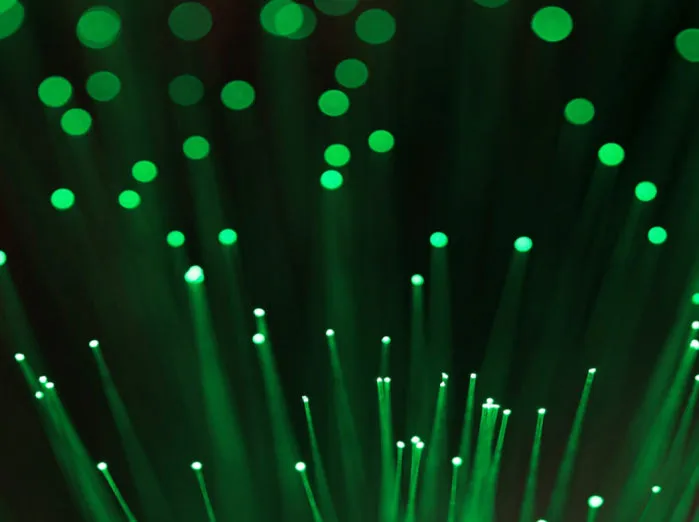
Fiber optic cables are revolutionary in the field of telecommunications and data transmission. They carry information as light signals through thin strands of glass or plastic, enabling faster and more efficient communication over long distances. Below is an explanation of how fiber optic cables work, broken down into key components and the overall process.At its core, a communications fiber optic cable consists of thin strands of glass, roughly the width of a human hair, that transmit data as light waves traveling at the speed of light. These fibers offer significantly more bandwidth than traditional copper cables, making them the preferred choice in today’s internet-driven world, where vast amounts of data (such as streaming content) need to be delivered to thousands of users over long distances almost instantaneously. Beyond telecommunications, fiber optic cables are also widely used in industrial networks, sensing technologies, and avionics systems.To understand how fiber optics work, it’s important to first grasp what happens when light passes through air or water. Light moves in waves, and as it travels through air, it loses energy and spreads out, causing the beam to become wider and less intense. This reduction in intensity is called attenuation.When light enters water, it doesn’t lose energy in the same way. Instead, the light bends around water molecules, allowing it to pass through more easily. Water also slows light’s velocity by a factor of 1/v², where v represents the speed of light in water. This means light can travel further through water than through air. Fiber optic technology harnesses these principles to transmit data efficiently over long distances.
In summary, fiber optic cables work by converting electrical data signals into light, which then travels through the core of the cable via total internal reflection. At the receiving end, the light signals are converted back into data, allowing for fast, reliable, and high-bandwidth communication.
Optical Fiber Cable
Modern optical fibers are typically made from pure silica glass, forming the core, which is surrounded by a cladding material made of doped silica. The core is so narrow that it only allows a single light ray, or mode, to travel through it at a specific wavelength—this is known as single-mode fiber. The cladding, with its lower refractive index, acts as a mirror that reflects the light back into the core, a phenomenon called total internal reflection, which keeps the light contained and moving through the fiber.The effectiveness of fiber optic cables is often measured by their ability to transmit light without significant loss. This is evaluated using return loss, or insertion loss, which compares the amount of light traveling forward through the fiber to the amount reflected back. Higher return loss indicates more light is lost, reducing the fiber’s efficiency, while lower return loss means more effective light transmission.Key Components of Fiber Optic Cables
- Core:
- The core is the thin, central strand of glass or plastic through which light travels. It is the most important part of the fiber optic cable, as it directly transmits data in the form of light pulses.
- Single-mode fibers have a smaller core, typically 8-10 microns in diameter, while multi-mode fibers have a larger core, around 50-62.5 microns.
- Cladding:
- The cladding is a layer of material surrounding the core. It has a lower refractive index than the core, which helps to reflect the light back into the core, preventing it from escaping. This reflection is essential for guiding the light along the length of the fiber.
- Buffer Coating:
- The buffer coating is a protective layer around the cladding that provides insulation, protection from damage, and additional strength. It helps protect the core and cladding from moisture, temperature variations, and physical stress.
- Jacket:
- The outermost layer of the fiber optic cable, the jacket, provides further protection. It is often made of durable materials like PVC, making the cable resistant to external environmental factors.
The Process: How Light Transmits Data
Fiber optic cables work by transmitting data as pulses of light. Here’s how the process works:- Light Source:
- Data transmission in fiber optics starts with a light source, typically a laser for single-mode fibers or an LED for multi-mode fibers. These devices convert electrical signals (the data) into light signals.
- Light Transmission:
- The light signals travel through the core of the fiber optic cable. The speed of data transmission is determined by the light frequency and the cable’s bandwidth.
- Total Internal Reflection:
- As light moves through the core, it bounces off the cladding due to the difference in refractive indices between the core and the cladding. This phenomenon is known as total internal reflection.
- It ensures that the light continues to travel along the fiber without escaping, even if the cable bends slightly.
- Repeating the Signal:
- Over long distances, the light signal can degrade or lose strength. To prevent this, devices called repeaters or amplifiers are used to boost the signal. This process helps the light pulses maintain their intensity and accuracy as they travel through the fiber optic cable.
- Receiving the Light:
- At the receiving end, a photodetector (typically a photodiode) converts the incoming light pulses back into electrical signals that can be interpreted by devices like computers, servers, or telecommunications equipment.
Advantages of Fiber Optic Technology
- Speed: Fiber optics transmit data at the speed of light, which allows for high-speed communication with minimal latency.
- Bandwidth: Fiber optic cables support a much higher bandwidth than copper cables, making them ideal for applications that require large data transfers.
- Distance: Light can travel over long distances (up to 100 kilometers or more for single-mode fiber) without significant signal loss.
- Reliability: Fiber optic cables are immune to electromagnetic interference, making them highly reliable even in electrically noisy environments.
How OWIRE Implements Fiber Optic Technology
At OWIRE, we produce high-performance fiber optic cables that follow this fundamental process of data transmission. Our range of cables includes single-mode and multi-mode fiber cables, FTTH cables, and armored fiber cables, all designed to provide maximum efficiency and reliability in data communication.With over a decade of experience, OWIRE offers cutting-edge fiber optic products that meet the industry’s highest standards. Our manufacturing process ensures top-quality cables that support fast, long-distance, and secure communication across various industries.By choosing OWIRE’s fiber optic cables, you ensure that your network infrastructure is equipped for the highest performance and efficiency.In summary, fiber optic cables work by converting electrical data signals into light, which then travels through the core of the cable via total internal reflection. At the receiving end, the light signals are converted back into data, allowing for fast, reliable, and high-bandwidth communication.